
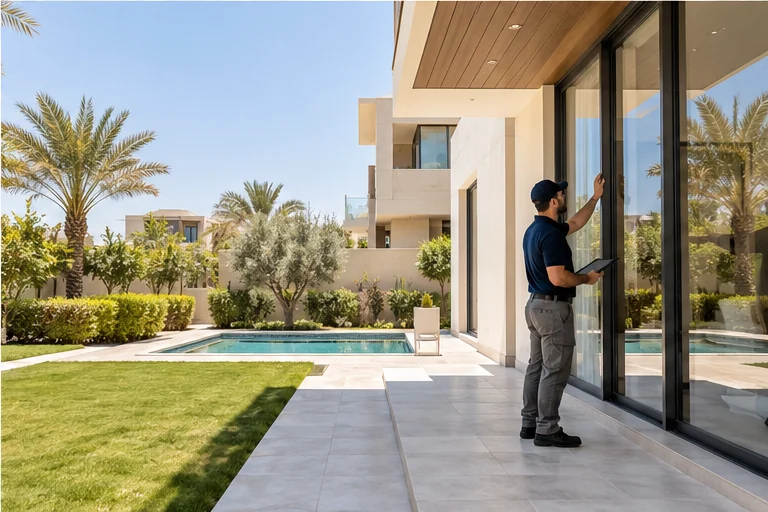
Who is the Villa Inspection for?
This service is for detached homes where the interior, the external envelope and outdoor space all matter. It suits:
- buyers taking handover of a new villa from a developer;
- families with a specific move-in date who want issues raised before furniture arrives;
- owners of larger homes who want the inspection scope written down clearly, area by area;
- owners abroad who need a thorough record and cannot walk the property themselves.
Buying a villa from its current owner? See the Resale Property Inspection.
What makes a villa different?
A villa is a standalone home rather than a unit within a block, so the inspection can cover more of your own property. It also means more is agreed in writing before the visit: a private roof, pool or plant room is confirmed as in scope only where it is yours, safely accessible and specifically included, while any shared community facilities stay outside the inspection.
External works. Driveways, paving, steps, boundary walls, gates and external lighting belong to the villa. They are walked in daylight, with attention to falls away from the building, finishes and visible outdoor fittings. See leaks or damage to visible outdoor fittings and sealant gaps around external frames.
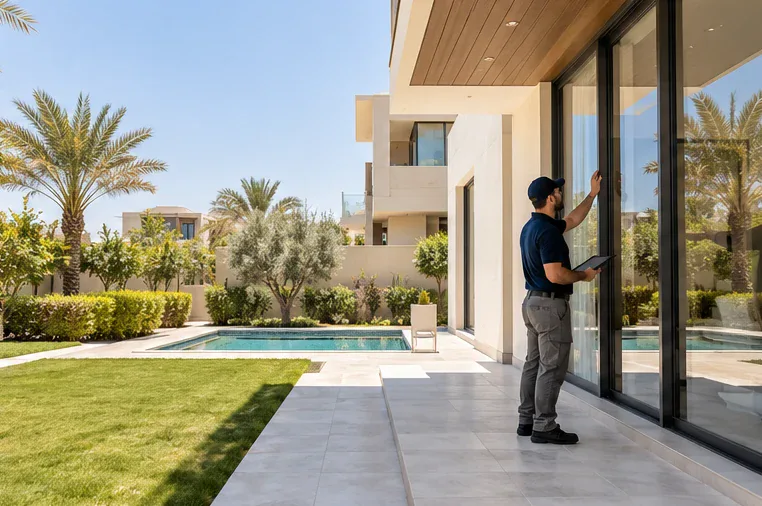
Large glazing and openings. Wide sliding or folding doors, garage doors and many windows are operated, locked and checked for alignment and seals. See sliding door seal gaps and window handles and locks.
Several cooling zones. Villas often have cooling split by floor or zone. Each zone is observed with the system running, so it matters that every zone is set up and switched on before the visit. See uneven cooling between rooms.
Terraces and balconies. Upper terraces need falls to working drains, sealed thresholds and secure balustrades. See water standing on terraces and loose balustrades.
Pools and plant rooms are specialist scope. Pools, spas, water features and plant rooms housing pumps, tanks, filtration or water heating involve specialist equipment and testing. They are not part of a standard Villa Inspection. If you want any of them considered, ask when you enquire: if it can be arranged, it is quoted as a separate, clearly described item.
When should a villa be inspected?
Book once the developer confirms the villa is complete and services are connected, and before you sign the final handover documents where the developer's process allows. With villas, also check:
- whether external works such as landscaping, paving and boundary walls are finished;
- whether each cooling zone has been set up and is running;
- whether the pool, if any, is filled and operating, if you want it considered within a separate scope;
- whether the developer will allow a longer visit, or more than one attendance, for a larger home.
A larger home may need more time on site. That is planned and stated in the quote rather than squeezed into a standard slot. Our Dubai handover checklist sets out the sequence from notice to keys.
What needs to be arranged before the visit?
- keys and access for every room, external door, gate, garage, staff accommodation and storage area in scope;
- water and electricity connected, and cooling running in each zone if possible;
- safe access to terraces and any roof area being inspected;
- outdoor areas clear of plant, materials and open excavations;
- any community gate or security registration completed in advance;
- written confirmation of any specialist items, such as the pool area, included in a separate scope.
If any of these are unavailable, the limitation is recorded in the report.
What is checked in a villa?
The scope is confirmed in writing. In a typical villa it covers the following, where present and safely accessible.
Interior
- reception, family and dining spaces: finishes, flooring, joinery and doors;
- the kitchen and any secondary or show kitchen;
- every bathroom and cloakroom: tiling, grout, sealant, fittings and drainage;
- bedrooms, dressing rooms and built-in storage;
- staircases, landings, handrails and balustrades;
- staff accommodation, laundry and storage rooms that form part of the villa.
Cooling and services
- air-conditioning response across each zone or floor, with airflow at outlets;
- extract fans in wet areas and the kitchen;
- visible sockets, switches and light fittings at user level;
- accessible visible pipework at fittings and under basins.
Glazing and openings
- large sliding or folding glass doors: alignment, operation, seals and locking;
- windows, handles and restrictors;
- external doors, thresholds and garage doors.
External envelope and outdoor areas
- visible façade finishes, sealant around frames and junctions at accessible levels;
- terraces and balconies: falls, drains and balustrades;
- the driveway, paving, boundary walls, gates and visible outdoor fittings;
- roof areas with safe permanent access, where included.

Villa: exterior inspection zones
- What you may see Roofline and visible coverings, external glazing and doors, boundary walls and gates, any pool or plant-room area, and the interior zones room by room.
- Why it may matter A villa has more of its own external and service areas than an apartment, so mapping them helps set out what will, and will not, be looked at.
- What this does not establish A standard inspection covers the villa’s own areas that are safe to access and agreed, which can include a private roof, garden or pool surround where they belong to the home. Pool plant and other specialist systems, and any shared or communal facilities, are not part of standard scope.
- A sensible next step Confirm in your written quote which of the villa’s own areas are in scope, and arrange specialist cover for pool plant or similar items where you want them assessed.
Illustrative guidance — technical review pending. Standard scope is the villa’s own, safely accessible areas; specialist systems and any shared facilities are separate.
Villa checklist
Extra points for larger homes with outdoor areas.
Interior
Outdoor areas
Specialist systems
Records
A general guide for your own walk-through. It does not replace a professional inspection, and it cannot show concealed defects. Take photographs of anything that concerns you and note the room.
What is outside a Villa Inspection?
Unless your quote expressly includes them, a Villa Inspection does not cover:
- pools, spas and water features, including their plant and equipment;
- plant rooms, tanks, pumps and water-heating equipment, beyond a simple visual check where safe and included;
- irrigation systems, landscaping and planting;
- solar or other specialist mechanical, electrical and plumbing (MEP) plant;
- structural assessment, invasive testing or opening up finishes;
- concealed services, waterproofing layers and below-ground drainage;
- security, smart-home or audio-visual systems.
What does a typical inspection day look like?
- Arrival and access. The inspection provider meets you, your representative or the developer's team, after any community gate registration.
- Walk-round and conditions. A short walk-round confirms which areas are open, whether services are running in each zone, and any areas unsafe or occupied by contractors.
- Interior, floor by floor. Rooms are checked in a consistent order, with wet areas and cooling checked in use and staircases checked by hand.
- Glazing and openings. Large sliding doors, windows, external doors and the garage door are operated and locked.
- Terraces and roof. Where safely accessible and in scope, terrace floors, drains, thresholds and balustrades are observed.
- External works. The driveway, paving, boundary walls, gates and visible outdoor fittings are walked in daylight. Any separately agreed specialist items follow their own scope.
- After the visit. Findings are organised by floor, zone and external area in a signed report, delivered in the format and timeframe confirmed in your agreement.
What does the report include?
Findings are organised by floor and zone, then by external area, so a large report stays easy to use. Each finding has a reference number, location, photographs, description, provider-defined priority and suggested next step. A summary shows the number of findings by area, and a clear limitations section records conditions on the day and any areas not inspected. Our guide on how to read a snagging report explains each part, and the sample report shows the layout.
What happens with the developer?
You submit the findings through the developer's formal process. Developers are expected to hand over in accordance with applicable contractual standards and to address eligible defects under relevant legal and contractual obligations. An inspection report can help you document concerns and follow up.
With villas, responses may involve several trades and suppliers, so:
- submit the complete report once and keep a dated copy with any acknowledgement;
- ask for a response for each item by reference number;
- keep a log grouped by area, so outdoor and specialist items stay visible;
- check whether equipment such as water heaters or pool plant carries a separate product warranty, and note its terms.
Our guide to following up with the developer explains how to keep the process moving, and our guide to Defects Liability Periods (DLP) and warranties explains how contractual and product warranties differ.
Can items be checked again after repairs?
Yes. A Reinspection (sometimes called de-snagging) checks the earlier findings by reference number. It is either included in your quote or arranged separately, on terms confirmed in writing.
Common questions
Is the swimming pool included?
Not by default. Pools involve specialist equipment and testing. If you want the pool area or equipment looked at, ask when you enquire so its feasibility and scope can be confirmed in the quote.
What about the plant room?
Plant rooms can hold pumps, tanks, water heaters and pool equipment. They are specialist scope. Where safe and included, the room may be observed visually; testing or start-up checks need a separately described scope.
How long does a villa inspection take?
It depends on the size of the villa and the agreed scope. Larger homes may need a longer visit or more than one attendance, which is set out in your quote.
Are the maid's room, driver's room and garage included?
Yes, where they form part of the villa and are accessible. List them when you enquire so they are written into the scope.
Can the roof be inspected?
Only areas with safe, permanent access and only if included in your quote. Roofs needing ladders or specialist access equipment are not assumed.
Is the landscaping checked?
Hard landscaping, such as paving, steps, boundary walls and gates, can be observed where it belongs to the villa. Planting, soil and irrigation systems are outside the standard scope.
Can a Villa Inspection be done for a resale purchase?
Yes. For a villa you are buying from an existing owner, the Resale Property Inspection is shaped for occupied or previously used homes.
Will the inspection tell me whether the villa is structurally sound?
No. It is a visual, non-destructive inspection. Structural assessment needs a separate engagement with a suitably qualified structural professional.
Request an Inspection Quote
Tell us about the property. We confirm the scope, its limitations and a quote in writing before you commit. Sending an enquiry takes no payment.